
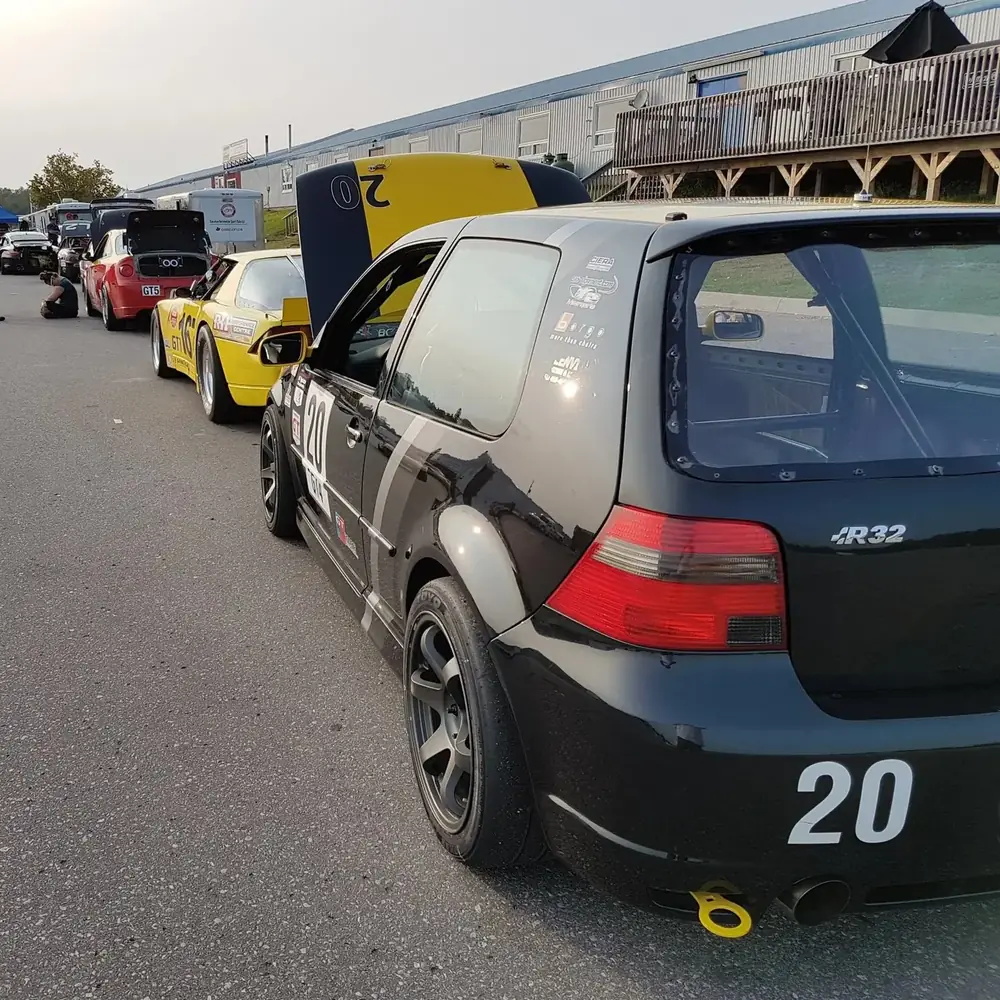
How to Survive Your First Endurance Race Without Crashing in Hour One
Patience is the entire game. Here's the mindset shift that saves your weekend — and your car.
Nobody wins an endurance race in the first hour
Every first-time endurance driver we've put in a car has had the same instinct: get out there, make up positions, prove they belong. It's completely understandable and it's the single most expensive instinct in the paddock.
An endurance race is decided by the team that has a car at the end. Not the fastest car — the car that's still running, still straight, and still on its original brake rotors. Your job in hour one isn't to gain positions. It's to hand off a car that your next driver can push in hour six.
Your real lap time target is 'consistent', not 'fast'
We'd rather see twenty laps within a second of each other than one hero lap and nineteen scrappy ones. Consistency means you're driving with margin. Margin is what absorbs the thing you didn't see coming — the car spinning out of the exit of turn 5, the sudden rain band, the flat-spotted tire.
A practical way to do this: pick a lap time you can hit while breathing normally, then hold it. If you find yourself holding your breath through a corner, you're driving above your margin.
Traffic is the whole sport
In a sprint race everyone is roughly the same speed. In endurance racing you'll share the track with cars twenty seconds a lap slower and cars ten seconds a lap faster, all at once. Learning to read traffic is more valuable than learning the perfect line.
- ◆Decide on the pass before the braking zone, not during it
- ◆Give slower cars the line they're already committed to — go around, not through
- ◆When a faster car catches you, be predictable: hold your line and lift briefly on a straight
- ◆Never pass on the entry to a blind corner just because you can
- ◆If you're not sure the pass is there, it isn't there. There's another lap.
Manage the car, not just the lap
Brakes, tires, fuel, and temperatures are all finite. Watch your gauges every lap on the straight — it takes half a second and it's the cheapest insurance in motorsports. Coasting a hundred feet earlier into a braking zone costs you a tenth and can save you a set of pads.
If something feels different, tell the radio immediately. 'It feels a little weird' is useful information. Nursing a problem quietly until it becomes a failure is not heroism, it's an expensive Sunday.
The handoff is part of your stint
Your stint ends the moment the next driver is belted in and rolling — not when you get out. Come in on the lap you're told, hit your pit speed, and give a clean, specific debrief: what changed with the car, where the track is dirty, which corners are picking up marbles.
Good handoffs are one of the biggest differences between teams that finish well and teams that just finish.
What we do with first-timers
We put you in the car with a coach on the radio, we set a lap-time window instead of a lap-time target, and we start your first stint in clean air where possible. Then we debrief with data. Most drivers find their pace by their second stint — and they find it without a single off-track excursion.